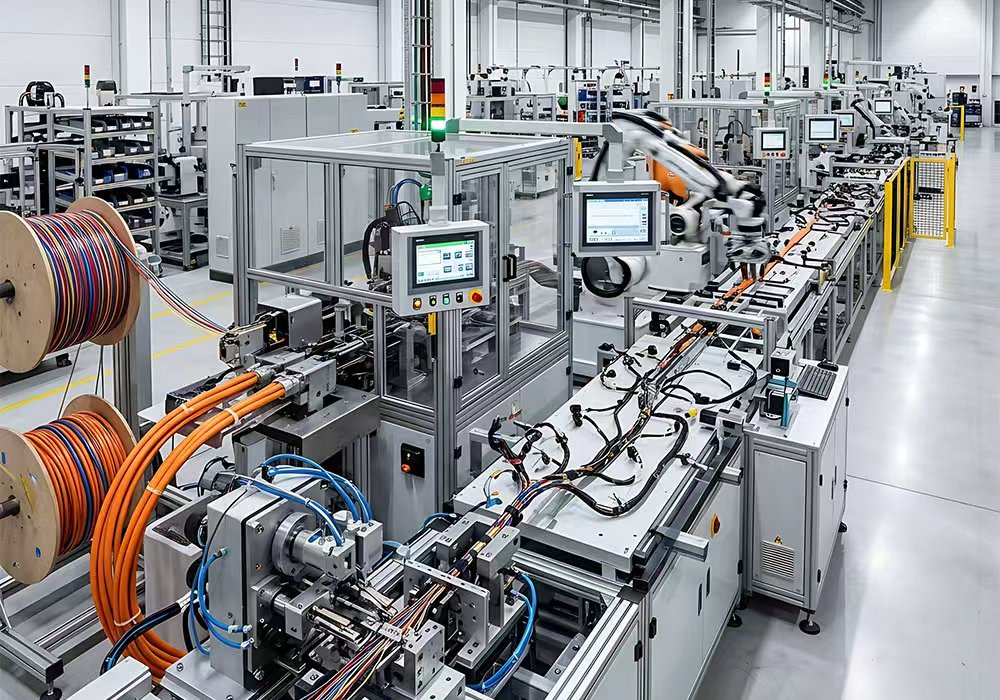
Industry: New‑energy high‑voltage harnesses, battery‑pack wiring, automotive sensor harnesses, charging‑gun assemblies, vehicle low‑voltage signal‑cable manufacturers.
Industry Pain Points:
Automotive harness manufacturing contains many manual‑intensive steps including cutting, stripping, crimping, soldering, sleeving and labeling. Manual stripping for large‑cross‑section high‑voltage cables frequently damages shielding layers and brings safety hazards. Manual crimping delivers unstable pull‑out force and fails IATF16949 consistency requirements. Manually‑applied labels are often misaligned with no QR‑code traceability. Manual‑recorded hi‑pot & continuity test data cannot be archived for OEM audits. Slow mold‑changing for charging‑gun over‑molding leads to long production downtime and low overall throughput.
Solution Provided:
Our self‑developed automation portfolio covers cutting, stripping, twisting, tinning, crimping, soldering, heat‑shrinking, coiling‑taping, servo‑labeling and final testing. Cable‑processing machines precisely handle large‑size high‑voltage cables without harming shielding layers. One machine replaces 3‑5 workers with stable crimp pull‑force. Soldering, spot‑welding and heat‑shrink machines realize standardized mid‑stage assembly. Servo‑driven print‑and‑apply labelers enable QR‑code traceability. Comprehensive cable testers automatically run continuity, insulation and hi‑pot tests and generate archivable reports for IATF16949 compliance. Vertical, C‑frame and double‑slide injection molding machines perform fast‑changeover over‑molding for charging‑guns and connectors, and can connect to recycling units to build closed‑loop production lines and raise overall throughput.