Contact Us
+86-0769 85982500
Customer Case Study · Consumer Electronics
Full-Process Intelligent Automation Equipment for Data Cables
Application in a high-speed data cable & consumer-electronics harness project — replacing manual stations with an integrated automated unit for cutting, stripping, soldering, labeling and electrical testing.
01 · Project Information
Consumer-Electronics Cable Manufacturer
Customer Industry
Consumer-electronic cable manufacturing, producing Type-C fast-charging cables, USB high-speed data cables and internal harnesses for smart-wearable devices, with large-volume export to Europe and North America.
Project Background
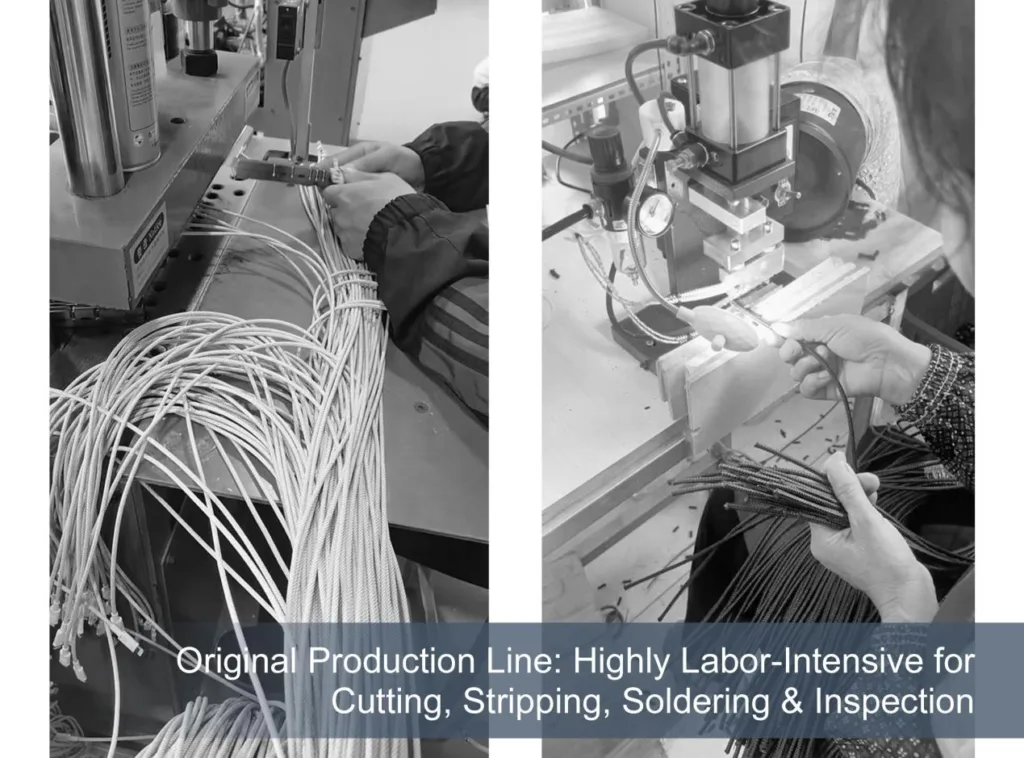
The legacy production line heavily relied on manual labor for cutting, stripping, soldering and testing. Rising overseas orders brought growing quality complaints caused by manual-induced shield damage, cold-solder joints and lack of batch traceability. This project deployed KexLink’s automatic data-cable production unit to replace multiple manual stations, improve processing quality for high-speed data cables and enable full-process electronic testing & batch traceability.
Focus Product: Full-Process Intelligent Automation Equipment for Data Cables
02 · Onsite Application Scenario
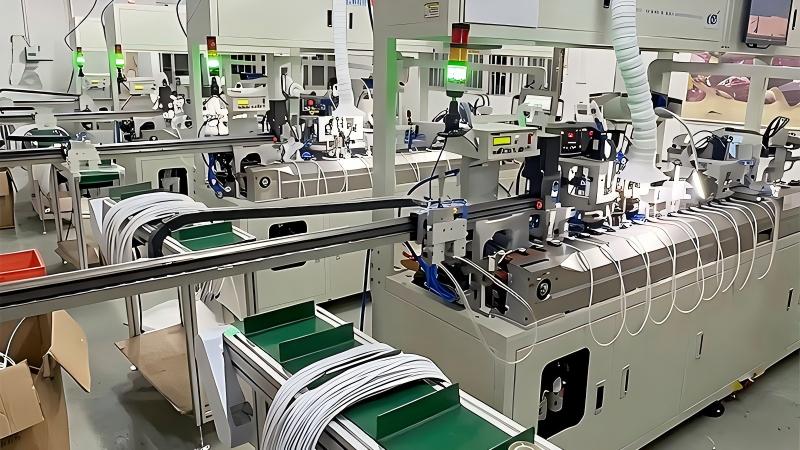
Deployed in the Customer’s Cable Assembly Workshop
The automation unit was installed in the customer’s cable-assembly workshop. It takes incoming raw cable and completes the full workflow — cutting, stripping, twisting, tinning, crimping, USB soldering, heat-shrinking, coiling & taping, servo QR-code labeling and final electrical testing.
Finished semi-products feed directly into downstream plug-injection stations for mass production of Type-C and USB-A high-speed fast-charging data cables.
03 · Customer Challenges
Pain Points on the Manual Line
Challenge 01
Thin shielding layers inside high-speed data cables were frequently scratched during manual stripping, causing unstable signal transmission and high risk of export returns.
Challenge 02
Manual soldering delivered poor consistency, with high cold-joint and missing-solder rates due to human variability in quality.
Challenge 03
Manual labeling had no QR-code batch traceability. Continuity and hipot test records were paper-based and failed traceability audits from overseas brand buyers.
Challenge 04
Expanding order volume faced labor shortage. Manual stations became a throughput bottleneck and could not match capacity-expansion targets.
04 · Key Outcomes
Product Configuration & Onsite Integration
Product Configuration
✔ Precision cutting & stripping moduleL
✔ Twisting & tinning module
✔ Automatic soldering unit
✔ Servo print-and-apply labeling module
✔ Integrated cable electrical-test module
Product Configuration
The unit connects with the customer's existing incoming-material workflow and downstream injection stations.
Stripping travel and force parameters were optimized specifically for the thin shielding layers of high-speed data cables to prevent shielding damage.
.
The built-in electronic test system assigns a unique QR code to every cable, with test data automatically archived..
The whole line runs continuously and automatically, with no manual material handling between stations.